DTF vs DTG vs Screen Printing: Best Guide for Custom T-shirts
Choosing between DTF vs DTG vs screen printing is an important decision in custom T-shirt production. For fashion startups, T-shirt brands, streetwear labels, private label brands, and bulk buyers, the print method affects cost, hand feel, color result, durability, MOQ, lead time, and final product quality.
The three common options are DTF, DTG, and screen printing. Each method works better for different fabrics, artwork styles, and order quantities.
This guide compares DTF vs DTG vs screen printing to help buyers choose the right method for custom T-shirts and other printed apparel.
Why Choosing the Right Printing Method Matters
For most apparel buyers, comparing DTF vs DTG vs screen printing helps clarify which method fits their fabric, artwork, order quantity, and budget.The printing method affects more than how a T-shirt looks. It also affects print feel, wash durability, sample cost, bulk price, MOQ, and production lead time.
For example, a 50-piece full-color streetwear drop may be better for DTF printing. A detailed cotton T-shirt graphic may work well with DTG printing. A 500-piece one-color logo order is usually more suitable for screen printing.
Before choosing between DTF vs DTG vs screen printing, buyers should confirm:
- Fabric type
- Garment color
- Artwork size
- Number of colors
- Order quantity
- Target price
- Desired hand feel
- Delivery timeline
The right method helps reduce sample issues and makes bulk production more predictable.
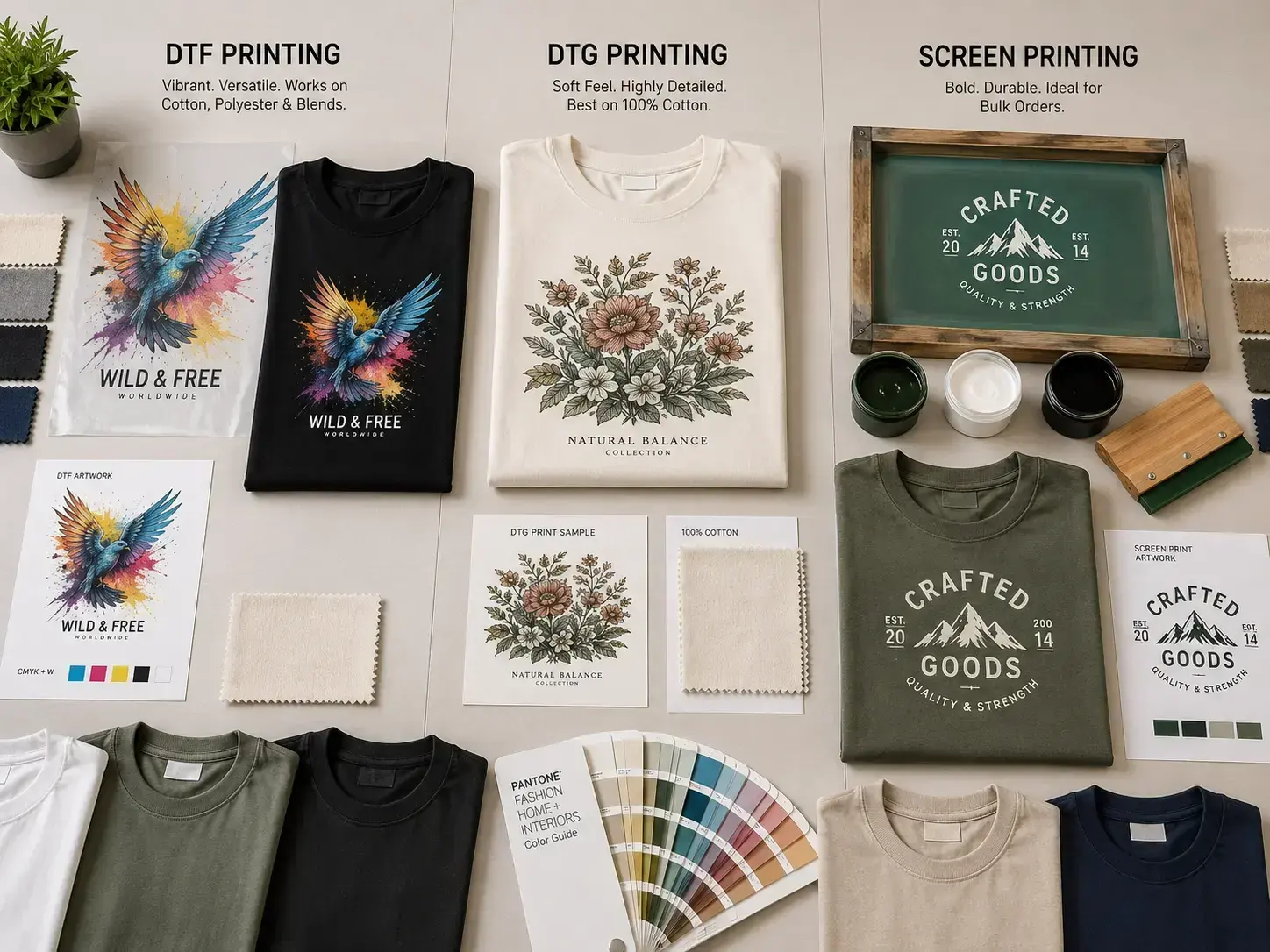
What Is DTF Printing?
DTF means Direct-to-Film printing. The artwork is printed onto a transfer film, covered with adhesive powder, cured, and heat-pressed onto the garment.
DTF printing is popular because it works on many fabric types, including cotton, polyester, and blended fabrics. It is suitable for colorful graphics, small to medium batches, streetwear designs, and orders with multiple garment colors.
DTF is often a good choice for:
- Colorful graphics
- Small to medium orders
- Cotton, polyester, and blends
- Streetwear T-shirts
- Multi-color logos
- Flexible design testing
The print usually sits on top of the fabric, so the hand feel can be slightly thicker than DTG, especially for large designs. However, DTF is flexible and practical when buyers need strong colors without high screen-printing setup costs.
What Is DTG Printing?
DTG means Direct-to-Garment printing. The artwork is printed directly onto the T-shirt using digital inkjet technology.
DTG printing works best on 100% cotton or high-cotton fabrics. It is suitable for detailed artwork, gradients, photo-style graphics, and designs with many colors.
DTG is often a good choice for:
- Cotton T-shirts
- Detailed artwork
- Gradient designs
- Small batches
- Soft print feel
- Photo-style graphics
Compared with DTF, DTG usually feels softer on suitable cotton fabric because the ink is printed into the garment. However, dark T-shirts often need pretreatment, and DTG is usually less suitable for polyester or low-cotton fabrics.
What Is Screen Printing?
Screen printing is a traditional printing method where ink is pushed through a mesh screen onto the garment. Each color usually requires a separate screen, so setup cost increases when the artwork has more colors.
Screen printing is strong for bulk T-shirt orders, solid-color logos, simple graphics, and repeat production. Once the screens are prepared, the unit cost becomes more efficient as order quantity increases.
Screen printing is often a good choice for:
- Bulk T-shirt orders
- Simple logo designs
- Solid-color graphics
- Streetwear drops
- Uniforms and event T-shirts
- Repeat production
Screen printing can also support special effects such as puff print, high-density print, water-based ink, and rubber print. It is usually not the best option for very small orders or artwork with many colors.The table below compares DTF vs DTG vs screen printing across print feel, fabric suitability, MOQ, cost, and bulk production efficiency.
| Factor | DTF Printing | DTG Printing | Screen Printing |
|---|---|---|---|
| Best For | Colorful graphics, small to medium batches | Detailed cotton T-shirt artwork | Bulk orders and solid logos |
| Print Feel | Slightly thicker surface feel | Softer feel on cotton | Depends on ink and print area |
| Color Result | Strong colors | Good gradients and details | Strong solid colors |
| Durability | Good with proper curing | Good on suitable cotton | Very durable for bulk orders |
| MOQ | Flexible for small runs | Flexible for small runs | Better for medium to large orders |
| Cost Logic | Based on print size and quantity | Based on print area and pretreatment | Based on color count and setup |
| Fabric Suitability | Cotton, polyester, blends | Best on cotton | Cotton, blends, selected fabrics |
| Artwork Complexity | Good for multi-color designs | Good for detailed designs | Better for fewer colors |
| Bulk Efficiency | Medium | Medium | High |

When comparing DTF vs DTG vs screen printing, the best choice depends on fabric, artwork, order quantity, and target price.
Which Printing Method Should Your Brand Choose?
Best for Colorful Graphics
For colorful graphics, DTF and DTG are usually better than screen printing.
Choose DTF if you need strong color coverage, flexible fabric use, and small to medium production runs.
Choose DTG if your T-shirt is cotton and the artwork has details, gradients, or photo-style effects.
Best for Cotton T-shirts
DTG is often suitable for 100% cotton or high-cotton T-shirts, especially for detailed prints.
Screen printing is also a strong choice for cotton T-shirts when the design uses fewer colors and the order quantity is larger.
Best for Bulk Orders
Screen printing is usually best for bulk orders. If your order is 300 pieces or more with a simple logo or limited-color design, screen printing often gives better unit cost and consistency.
Best for Small Batches
DTF and DTG are usually better for small batches because they require less setup than screen printing.
For startup brands testing new graphics, DTF is often practical because it works on many fabrics and garment colors.
Best for Streetwear Effects
Streetwear brands often use a mix of methods. DTF works for colorful graphics, screen printing works for bulk drops, puff print adds raised texture, and embroidery works for small premium logos.
Fabric Suitability Guide
| Fabric / Product Type | Recommended Method |
|---|---|
| 100% cotton T-shirts | DTG or screen printing |
| Heavyweight cotton streetwear T-shirts | Screen printing, DTF, puff print |
| Cotton-polyester blends | DTF or screen printing |
| Polyester sports T-shirts | Sublimation or DTF |
| Performance T-shirts | DTF or sublimation |
| Small premium logos | Embroidery or screen printing |
| Full-color graphics | DTF or DTG |
| Bulk solid-color logo orders | Screen printing |
This is only a general guide. The final printing method should be confirmed through fabric, artwork, quantity, and sample testing.
Artwork and Sample Requirements
Good artwork files help avoid sampling mistakes and bulk production issues.
For custom T-shirt printing, buyers should prepare:
- AI, PDF, EPS, SVG, or high-resolution PNG files
- Artwork size
- Print placement
- Garment color
- Fabric type
- Pantone or color reference
- Quantity by design and size
- Preferred print method
- Delivery timeline
For screen printing, artwork may need color separation. More colors can increase setup cost because each color may require a separate screen.
For embroidery, artwork may need digitizing before production. Embroidery cost depends on stitch count, logo size, and placement.
Before bulk production, buyers should approve a printed sample. Check print size, placement, color, hand feel, fabric compatibility, stretch behavior, and wash performance if needed.
How MX Clothing Can Help
MX Clothing helps fashion startups, T-shirt brands, streetwear labels, private label brands, and bulk buyers choose between DTF vs DTG vs screen printing for custom apparel.
If you already know the printing method, MX Clothing can review your artwork, fabric, garment color, print size, placement, and quantity before sampling. If you are unsure, the team can suggest a practical method based on your design, fabric, order size, budget, and timeline.
MX Clothing can support:
- DTF printing for colorful and flexible designs
- DTG printing for detailed cotton T-shirts
- Screen printing for bulk T-shirt orders
- Puff print for streetwear effects
- Embroidery for small premium logos
- Printed samples before bulk production
- Private label T-shirts with labels and packaging
To start a printing review, buyers can send artwork files, reference photos, T-shirt fabric, garment color, print size, placement, estimated quantity, delivery country, and target timeline.

Final Thoughts
When comparing DTF vs DTG vs screen printing, there is no single best method for every custom T-shirt project.
DTF is flexible for colorful graphics, small batches, and multiple fabric types. DTG is suitable for detailed cotton T-shirts with a softer hand feel. Screen printing is often the best choice for bulk orders, solid-color designs, and repeat production.
The right method should match your fabric, artwork, order quantity, budget, and brand positioning. Before bulk production, always approve a printed sample to confirm color, placement, hand feel, and durability.
Contact Us
FAQ
Is DTF better than DTG for custom T-shirts?
DTF is better for flexible fabric use and colorful graphics, while DTG is better for detailed artwork on cotton T-shirts with a softer hand feel.
Is screen printing cheaper for bulk T-shirt orders?
Yes. Screen printing is usually more cost-effective for bulk orders because setup cost is spread across more pieces.
Which printing method is best for colorful graphics?
DTF and DTG are both good for colorful graphics. DTF works on more fabric types, while DTG works best on cotton T-shirts.
What fabric is best for DTG printing?
DTG printing works best on 100% cotton or high-cotton T-shirts. It is usually less suitable for polyester or low-cotton fabrics.
Do I need to approve a print sample before bulk production?
Yes. A printed sample helps confirm print size, placement, color, hand feel, fabric compatibility, and wash performance before bulk production.
READ NEXT
Related Articles


POPULAR PRODUCTS
Hot Selling Products